Archive
linguistics

I was listening to NPR as I drove to New Brunswick the other day (I know, so typical!) and I heard about Eliot Spitzer’s plans for his inaguration. The ceremony is scheduled to take place at noon on January 1, after a more official midnight swearing-in. The event is open to the public, but it will be held behind the state capitol, which is to say, outdoors. Governor-elect Spitzer wryly noted that the Old Farmer’s Almanac predicts that the temperature will be “nearly negative 15” on that day.

I started thinking about the ambiguity of that phrase, how nearly with positive numbers seems to scope downward: “nearly five” could be four, but not six. So does “nearly negative 15” also scope downward? Or does the inclusion of a negative invert the scope direction? If it’s -14 degrees, is it “nearly negative 15”? Putting aside for the moment the question of whether nearly patterns like most in that, say, five entails nearly five, it appears that pragmatics forces an interpretation of scopal direction away from some “normal” (gleaned from world knowledge) so that the negative number isn’t in play so much as the direction of the divergence from what’s expected. On August 15th I could say “it was freezing today — it was nearly 50 degrees!” and that would be felicitous if the high that day was 53.

Returning to the question mentioned above, I am of the opinion that our intuitions on this come from a pragmatic rather than semantic place, although I can’t imagine that anything I could say on the topic of near would ever top what the kid in the green and white striped shirt says in this clip:

[QUICKTIME http://www.tractorfeed.com/strictlyspeaking/sounds/near.mov 320 257 false true]

“It isn’t even near it — it’s touching the box!”

Read More
So it seems that when you drive north of here along the coast, you run into people who substitute some kind of long [a] for the syllabic [r] in word final position. And these people are up in arms about the “langostino lobster” which is starting to appear on menus, often just called “lobster” — the nerve! Senator Olympia Snowe, of my summerhome-state of Maine, is apparently “hot” about the issue (CNN’s word, not mine), and the Maine Lobster Promotion Council contends that these upstart langostinos “cost Maine fishermen $44 million in lost sales to restaurant chains since April.” I tend to think it’s global warming that’s the lobster fisherman’s real enemy, but whatever.
So much depends upon a name. It turns out that the langostino lobster is not really a lobster so much as a crab. The FDA, ever vigilant about market forces, approves “langostino” as a market name for two species: Cervimunida johni and Pleuroncodes monodon. Good thing, too, for those who would sell these insects of the sea, as the “common name” of this creature is the squat lobster. Somehow people don’t want to eat something called the squat lobster, but they’ll gobble up “langostino” lobster. At some point you must have tried the trendy Chilean Sea Bass, but probably only after its redesignation as such. Would you have ordered it back when it was called Patagonian toothfish? Or perhaps you fancy a plate of blackened wartynosed mullet? This last one is an actual type of fish recognized by the FDA’s list of market names for seafood. Is there any question why this fish hasn’t made it to the lofty heights of episode ingredient on Iron Chef?

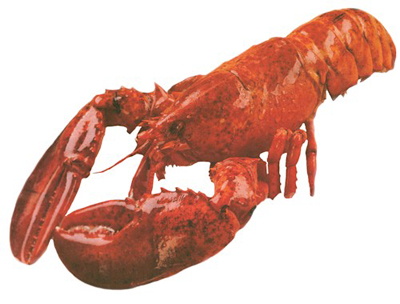
To sum up, here’s the langostino lobster:


and here’s a real lobster:

As for me, I prefer crab.

Read More

BBC NEWS | Business | US shares flat after tricky week

I read this headline on the BBC news front page and I was thinking “aww how cute, the US is going to share his flat with someone after a tricky week.”  Really, it wasn’t until I clicked on the link that I realized that shares was a noun and flat an adjective in this use.

Read More

Why am I so excited that Jersey City has its own fake-graffiti-covered red plastic street dispenser of free issues of the Village Voice? And why is it that as soon as I typed the previous sentence I started wondering if my adjective order complies with the “Royal Order of Adjectives” (observation, size, shape, age, color, origin, material, qualifier)? And finally, who ever thought I would be able to tick both the “Jersey City” and the “linguistics” category boxes for the same post?

Read More

I’m reading a Kratzer that deals with inherent modality. She discusses some suffixes in German which make adjectives out of verbs, roughly analagous to -able in English. So I started thinking about edible, and whether the semantic content requires that it only modify items which would cause no ill effects if ingested. Various dictionary definitions assert that it describes something “fit” or “suitable” for eating. Are oleander leaves edible? They are extremely toxic and can cause death if eaten, so perhaps they do not count as “edible” and yet it’s clear that they can be eaten: just put some in your mouth, chew, and swallow. I’m still not convinced that the meaning of edible is anything beyond “can be eaten;” I think we tend to use it to describe that which a human can ingest without harm, but there are clear counter-examples to this where the use of edible is completely licensed.  Every year on January 1, some number of Japanese people choke to death eating a holiday soup containing mochi, large blobs of glutinous rice.  They eat the mochi, which is edible, and yet it causes harm.  So on this account, oleander leaves should be edible as well, because one can eat them, but they end up causing harm.  Forgive the pun but I think this boils down to my overwhelming tendency this semester to seek out pragmatic explanations and leave the semantics underdetermined.

Read More

So it occurred to me today that the expression “at arm’s length” could indicate close just as easily, if not more so, than the far it’s usually taken to mean. Obviously convention dictates far, but if something is one arm’s length from you it’s really not distant at all. “At arm’s length” would by definition also be “within reach.” And is it supposed to be my arm? How does that bare ‘arm’ achieve NP status without a determiner or quantifier?

Read More

Sweet.  This renews my enthusiasm for finishing my OT analysis of Batman punch words.

Read More

I read a sentence on Laura Holder’s site and apparently my sentence processor will not be defied in its demand to attach low, because I could only get one reading for it (not the correct one, either). Here’s the sentence:

Manhattan judge ruled photographer Philip-Lorca diCorcia was within his rights to sell copies of a photograph he took of man using a concealed camera

Even after clicking through and looking at the photo in question, and reading the article, I was convinced that the photo was of a man who was using a concealed camera,  and I kept looking at the photo to see if I could detect the hidden camera…

Read More

In the US, we sometimes use the phrase blue ribbon whereas in the British empire they say blue riband. Look it up.

Read More


urgenteyextranjero

Originally uploaded by sararyan.


What occurred to me when I looked at this photo and its caption (Put your urgent foreign mail into this lion’s mouth) is that the use of AND here could be interpreted either with the distributive or collective reading: does the lion accept mail that is either urgent or foreign? Or does an individual piece of mail have to be both urgent and foreign for it to enter the mouth? The former reading is probably more likely, but ignoring for the moment VPs which *require* collective readings (gather, be numerous), it seems like the distributive reading tends to be preferred, ceteris paribus: ‘these letters are urgent and foreign’ seems to require that each letter be both urgent and foreign. Or perhaps my intuitions are shot to hell and I am completely wrong about this. I know this mereology stuff is oh so popular these days with the semantico-philosophy set, but it’s always seemed to me like something pragmatics should solve.

Read More